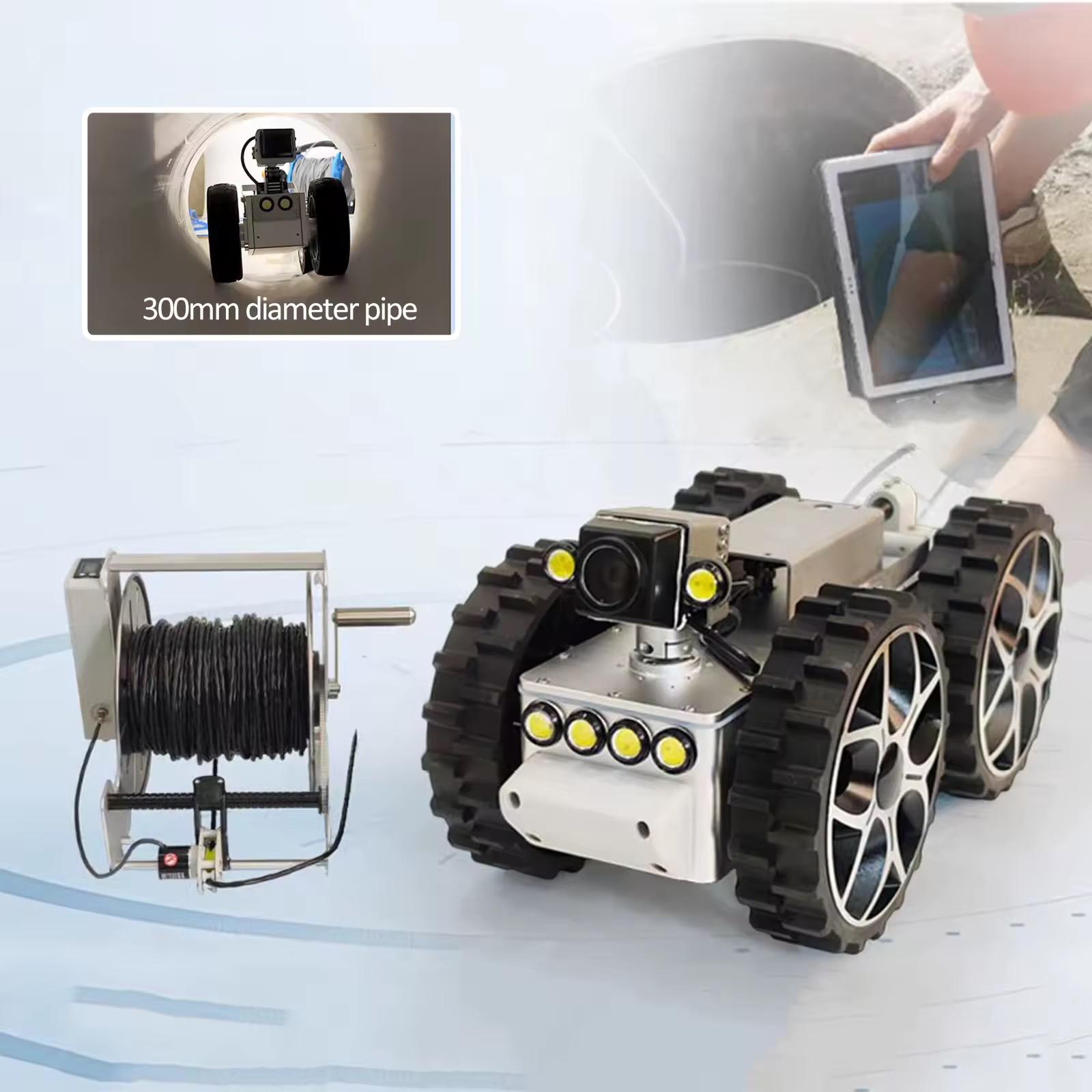
I. Core hardware functions: movement and perception
This is the “body” and “sensory” of the robot, which determines whether it can “enter and see clearly”.
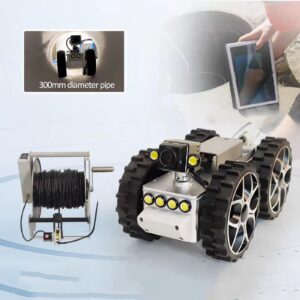
· Crawler sports chassis: this is the most critical hardware. It adopts a crawler + suspension system, which can easily climb 30° slopes and cope with sludge, gravel and vertical climbing. Some models can even reconstruct the form (such as spiral) to solve the problem of “well depth, heavy silting, and variable diameter”.
· Multi-dimensional perception system: In addition to high-definition camera “eyes”, it also integrates lidar (for map positioning), sonar (for underwater contour scanning) and infrared thermal imaging (for detecting temperature abnormalities).
· Underwater adaptability: For underwater operation, the shell needs to be sealed and waterproof (such as aviation aluminum material, pressure resistance of more than 50 meters), and equipped with long-distance cables.
II. The role of intelligence: the value of SDK and API
This is the “brain” of the robot, which determines whether it is “smart or not”. SDK (Software Development Kit) and API (Application Interface) are the keys to upgrading ordinary machines to “intelligent detection systems”.
· Real-time data return and processing (SDK core): Through the RTSP/RTMP video transmission protocol, the collected images are transmitted to the ground station in real time without loss. The algorithm can dynamically superimpose watermarks (time, GPS) in this link and identify defects in real time, so that the data can be used immediately.
· Precise control and automation (API core): control robot movement, gimbal rotation, lighting adjustment, etc. through API. The advanced model supports AI-assisted control, such as the robot autonomously identifies the pipeline interface and automatically adjusts the posture.
· System integration and remote collaboration: seamlessly connect to the intelligent management network GIS system or remote command center through API, so that the detection data is no longer an island, but directly managed into the warehouse.
III. Typical application scenarios and values
· Scenario 1: Urban drainage and sewage pipe network: The risk of traditional artificial downhill is extremely high (toxic gas). Robots can replace people in pipeline disconnection, corrosion and sedimentation judgment, and even work with sonar in high water level environments.
· Scenario 2: Industry and energy (nuclear power/chemical industry): Enter the nuclear radiation area or high-temperature and high-pressure pipeline, and use the AI algorithm to automatically identify corrosion, coating shedding, and even abnormal sound of auscultation equipment.
· Scenario 3: Deep-sea oil and gas pipeline (deep-water engineering): Use the combination of “unmanned boat + underwater robot” to observe the “mud point” of the pipeline in the 1500-meter deep water to prevent structural damage caused by bending, which is completely untouchable by human.
Reviews
There are no reviews yet.