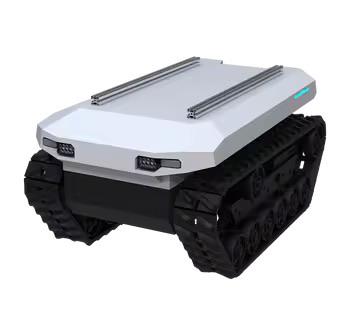
Its functions and effects are mainly divided into the following three levels:
1. Core function: as a “universal mobile base”
It provides a platform for upper-level devices to move stably in extreme environments:
· All-terrain passability: specially designed for roadless environments. The grounding ratio of the crawler structure is low, which can easily cope with swamps, snow, deserts, steep slopes and other scenes; some high-end models also have the ability to float and wade.
· Strong power and load: When the dead weight is about 500 kg, it can still carry an extreme load of 1,000 kg, and the power transmission system is also strengthened for heavy-duty climbing.
· Remote control and autonomous navigation: Support remote control within the visual range (usually 300 meters to more than 1 kilometer), and can also realize autonomous modes such as SLAM drawing, path planning and “following” by installing a navigation kit.
2. Main function: Multi-scene “Transformers”
Equipped with different top-mounted equipment, it can become different professional equipment:
· Special transportation and logistics: act as an unmanned supply vehicle to transport ammunition/materials or tow trailers in battlefields or disaster areas; in the field of construction/agriculture, it transforms into an unmanned vehicle to carry building materials and spray pesticides.
· Hazardous environment operation: Equipped with a robotic arm for detonation, capture and nuclear biochemical (CBRN) detection, or used for mine underground exploration and rescue.
· Security and reconnaissance: Equipped with photoelectric probes and radars, you can patrol autonomously around the border or important facilities for a long time, and can also provide real-time reconnaissance images for the rear.
· Scientific research and education: As an ROS development platform, it is available for colleges and universities to verify algorithms such as autonomous driving and multi-machine collaboration.
3. The core difference from the traditional AGV/AMR
Compared with the indoor AGV you are familiar with, the difference is very clear:
· Application scenario: AGV mainly serves indoor structured roads (such as factories); and this kind of chassis mainly responds to outdoor all-terrain (roadless, muddy).
· Navigation mode: Traditional AGV relies on magnetic stripe/QR code (fixed route); this kind of chassis usually uses laser/visual SLAM to achieve autonomous navigation and dynamic obstacle avoidance.
· Chassis structure: mostly wheeled, with high requirements for the ground; while it adopts a crawler type, which is good at climbing and crossing ditches.
· Core tasks: mainly do the logistics and handling of “moving boxes”; it focuses on “carrying tasks after arriving at the scene”, taking into account special operations (such as detonation and reconnaissance).



Reviews
There are no reviews yet.