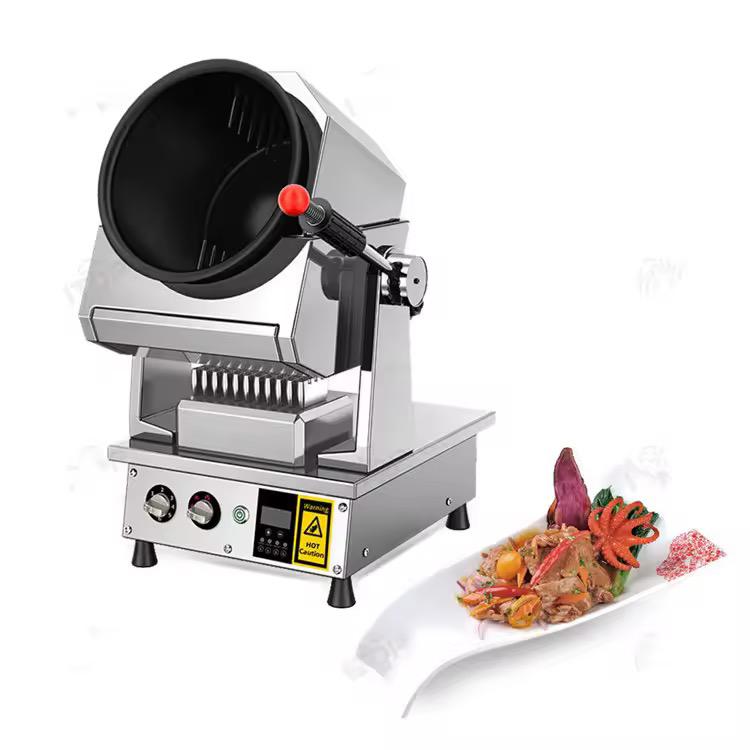
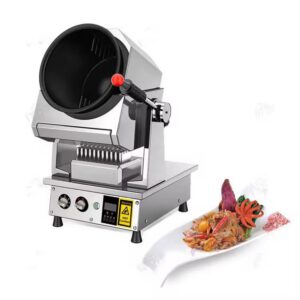
This kind of equipment adopts a horizontal or vertical drum design to heat the ingredients evenly through 360° rotation. The main functions are as follows:
· 360° uniform stir-frying: simulate the chef’s spoon by rotating the roller, so that the ingredients roll up and down and are heated evenly, avoiding the common problems of pasting pot or pinching raw in traditional wok.
· Intelligent one-click operation: equipped with PLC or touch screen control, thousands of recipes can be stored. The staff only needs to put in the ingredients, and the machine will automatically adjust the heat, stir-fry, and even add seasoning and water accurately.
· Automatic cleaning and discharge: It has the function of 90° turning the pot and automatically serving dishes. Some models are also equipped with high-pressure water guns, which is convenient for quick cleaning and improving the efficiency of serving.
· High-efficiency and energy-saving design: The thermal efficiency of electromagnetic heating can reach more than 90%, which is about 48% more energy-saving than gas. At the same time, it greatly reduces the room temperature of the kitchen and improves the working environment.
· Reduce manpower dependence: A chef can operate 3-5 units at the same time to solve the problem of recruitment difficulties. Standard dishes such as fried rice and pot dishes can be served in a few minutes.
2. Collaborative robot (robot arm)
This kind of equipment usually refers to a cooking robot with a 6-axis robotic arm, which mainly imitates human hands for refined operations:
· High-precision bionic action: Through AI learning to copy the chef’s action, it can complete difficult operations such as frying steak and pulling coffee, and the wrist joints can rotate 360 degrees.
· Unattended operation: small area (about 2 square meters), customers can automatically complete the production after scanning the code, which is suitable for new retail scenarios.
Summary of the core role
The introduction of this kind of equipment has three main functions: product standardization (ensure that the taste of each store is consistent), cost reduction and efficiency increase (fast serving and saving manpower), safety and environmental protection (no hidden fire hazards, reducing oil smoke).
Reviews
There are no reviews yet.