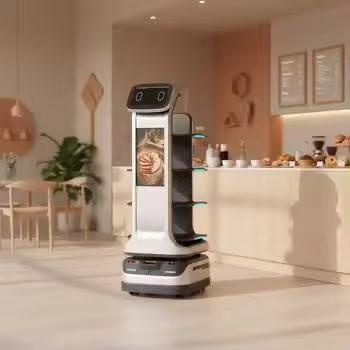
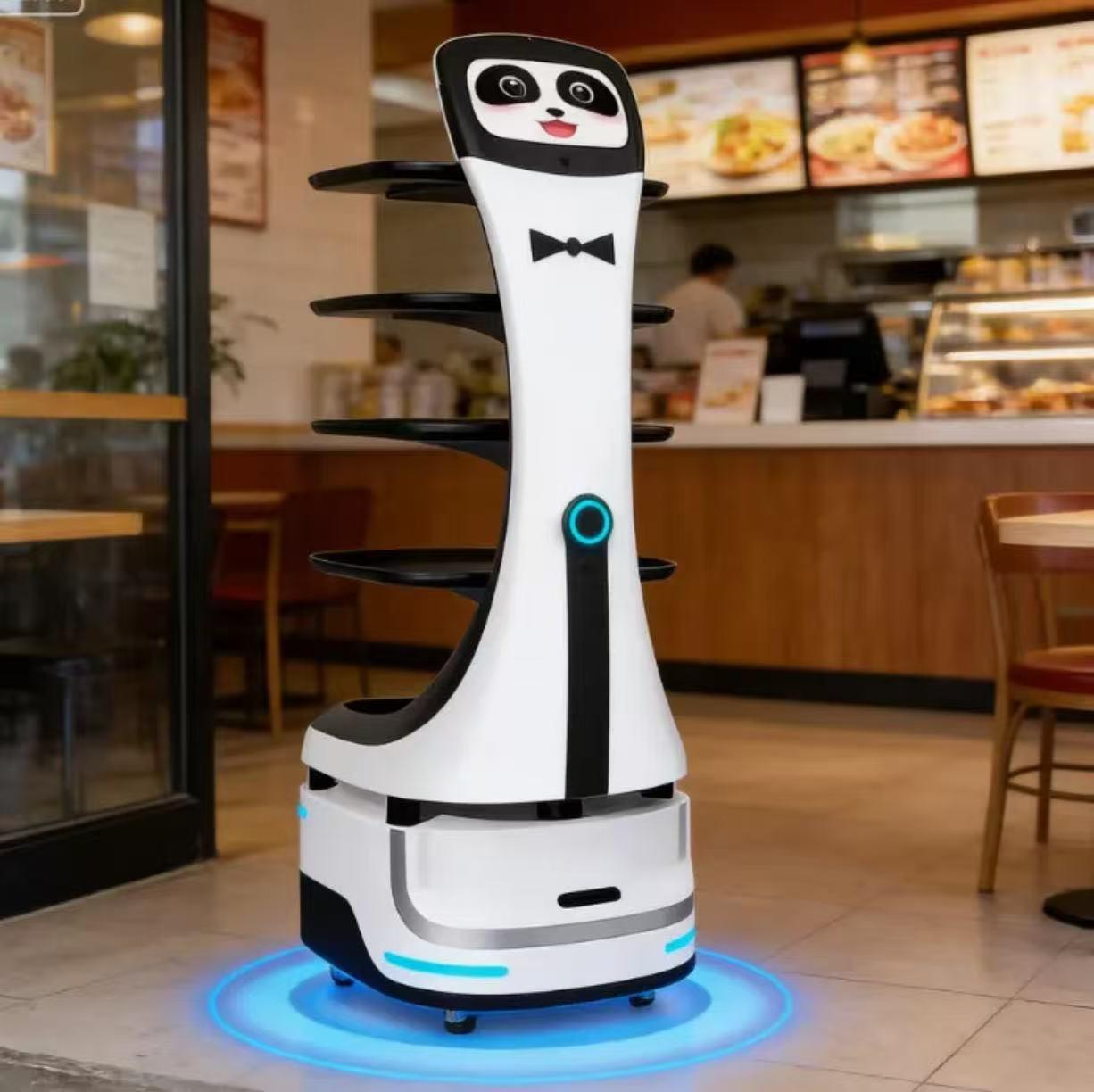
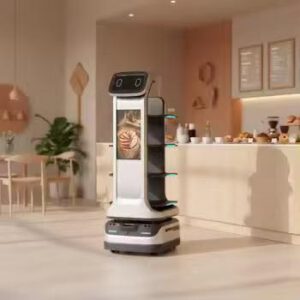
The core function of intelligent automatic navigation food delivery robot is autonomous movement and precise distribution. Its function is to reduce costs and increase efficiency for restaurants, hotels and other scenarios and improve service experience. It is not a simple “walking tray”, but a “digital employee” that integrates environmental awareness, AI decision-making and human-computer interaction.
The following is the specific classification analysis:
🤖 Core technical functions
1. Autonomous navigation and SLAM technology: This is the “cerebellar” and “eye” of the robot. It uses lidar, depth camera and other sensors to instantly build maps and position in unfamiliar environments through SLAM technology to achieve centimeter-level precision. High-end models have been able to get rid of the dependence on ground magnetic strips or QR codes and realize “trackless” autonomous navigation.
2. Intelligent perception and dynamic obstacle avoidance: In the face of pedestrians in the restaurant or sudden obstacles, the robot no longer “stops when encounters obstacles”, but adopts predictive obstacle avoidance algorithms to predict and plan the detour path in advance to ensure the safety and efficiency of the human-computer mixed environment.
3. Multi-modal AI intelligent interaction: After introducing a large language model, the robot can not only broadcast the name of the dish, but also conduct multiple rounds of natural dialogue, introduce dishes, and even “actively solicit customers”, upgrading from a simple “food delivery worker” to a “shopping guide”.
4. Smooth motion control: In order to prevent soup from spilling, high-end products adopt a vehicle-level independent suspension system, combined with sophisticated motion control algorithms, to ensure that it runs smoothly when stopping, turning or crossing bumps.
📝 Scenario function and role
· Back chef to table (indoor distribution): undertake high-intensity and repetitive food delivery work. The average daily delivery volume of a robot can reach 400-600 discs, which is 2-3 times that of labor, which effectively alleviates the pain point of “high manpower costs” in the catering industry. Models such as Purdue Technology’s “Bella” also add emotional interaction and interest through bionic design; Orion Starry Sky “Coucai Leopard” supports the dual mode of “delivery food when busy and soliciting customers when idle”.
· Hotels and buildings (cross-floor service): open the “ladder control system”, autonomously take the elevator, cross-floor distribution, and complete tasks such as guest room delivery and welcome.
· Outdoor and semi-closed (long-distance distribution): suitable for airports, parks and other complex scenarios. For example, Meituan’s “Little Hornet” has been on duty at domestic airports to solve the pain points of long-distance meals for passengers; the completion rate of Serve Robotics on urban sidewalks is as high as 99.8%; DoorDash’s “Dot” can reach a maximum speed of 32km/h and a load capacity of 13.6 kg.
💎 Summary and benefits
For operators, food delivery robots are a tool to reduce costs and increase efficiency. In addition to directly saving manpower costs, some models (such as DoorDash’s Dot) also introduce intelligent weighing in the packaging process, which reduces the number of missed delivery complaints by 30%. For consumers, they bring a stable and novel experience. Not only is the delivery more punctual, but the zero-error “insensitive meal pick-up” and interesting AI interaction are also improving the dining experience.
The function of the food delivery robot has evolved from a simple “transportation” to a “digital employee” integrating autonomous navigation, intelligent interaction and multi-machine collaboration. Its core value is to reduce costs and increase efficiency for restaurants, hotels and other scenarios, improve service experience and expand new commercial space.
🤖 Core technical functions
· Autonomous navigation and precise positioning: Using lidar, depth camera and other multi-sensor fusion technologies, trackless autonomous navigation can be realized through SLAM instant positioning and map construction. The high-end model can run stably in a 30-meter-high lobby or long corridor, and the positioning accuracy can reach the centimeter level (±5cm).
· Intelligent perception and dynamic obstacle avoidance: Equipped with multi-sensor arrays such as RGBD depth cameras, it can perceive the environment in real time and predict the trajectory of obstacles. In the complex scene of people shuttle, it can be “predicted” and detoured like human beings, instead of stopping when encountering obstacles.
· Large capacity and multi-functional cabin: Some models have a load space of up to 190L and a load capacity of 42kg. The closed cabin supports the expansion of disinfection, heating, refrigeration and other functional kits to ensure food hygiene and the best eating temperature.
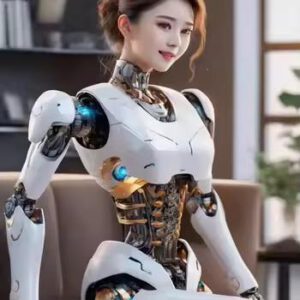
· Anthropomorphic AI interaction: With the help of the big language model, the robot can not only broadcast the meal number by voice, but also conduct multiple rounds of natural dialogue, introduce dishes, interact with customers, and even improve public affinity through LED “eye” to change expressions like DoorDash’s “Dot”.
🏢 Scenario application and function
· Indoor restaurants and hotels: undertake high-intensity food delivery and guest room delivery, and the average daily delivery volume of a robot can reach 400-600 plates. In the hotel scene, it can realize cross-floor independent stairs, shorten the takeaway delivery time from 15 minutes to 5 minutes, and greatly reduce the pressure of the waiter.
· Outdoor and closed parks: For example, the “Dot” robot of DoorDash in the United States can drive on sidewalks and bicycle lanes at a speed of 32km/h and a load capacity of 13.6 kg, which is specialized in solving the “last kilometer” distribution. With the use of smart scales, it can reduce the number of missed complaints by 30%.
· Multi-machine collaboration (the latest trend): At the Zhongguancun Forum in 2026, robots from different manufacturers realized “group intelligence” for the first time – the whole process of stringing candied haws, making coffee, picking up meals, and delivering food is scheduled by a unified “brain”, and it only takes 2 minutes from ordering to picking up meals. This marks that robots are moving from “single-machine operation” to “team collaboration”, providing a replicable model for unmanned intelligent restaurants.
In general, the food delivery robot not only helps the boss solve the problem of “difficult recruitment and management”, but also improves the overall dining experience of customers through novel interaction and stable service.
Reviews
There are no reviews yet.